Books
The Psychology of Rough Water
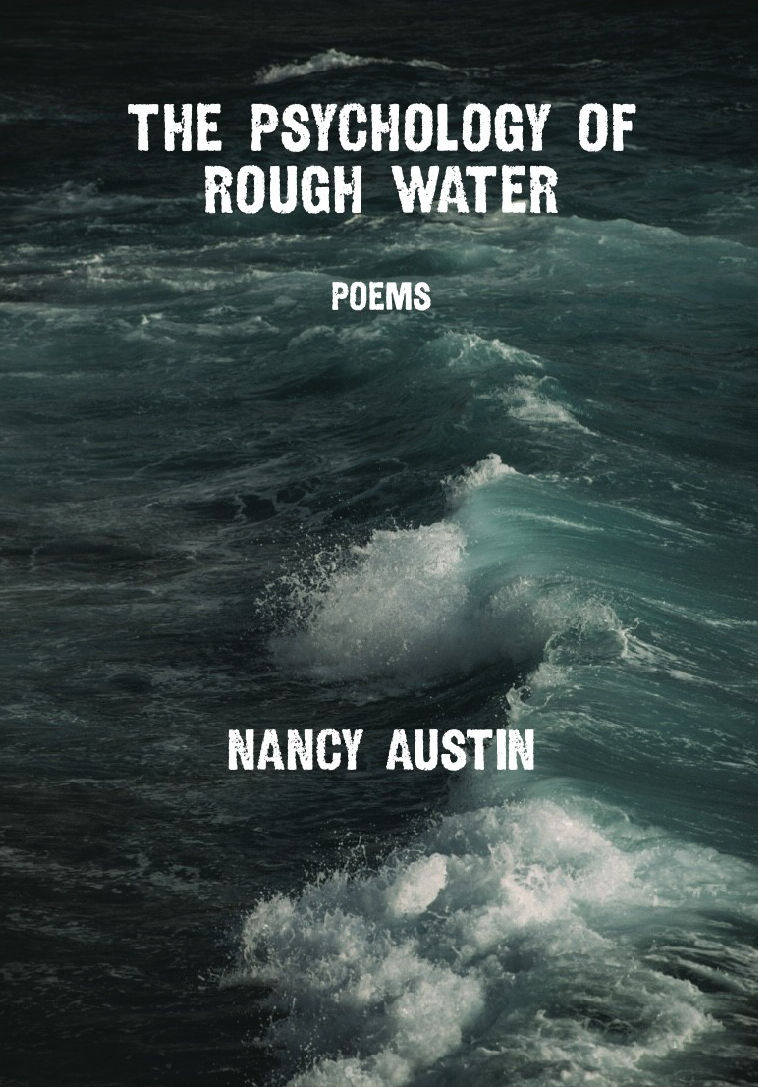
Readers shared thoughts...
“Forest Bathing,” the first poem in Austin’s collection, is a perfect metaphor for what follows. These poems will take you, like a day in the forest, down varied trails, some easy and peaceful, others challenging as they show the heartache and difficulties of relationships. You will emerge from these poems believing that rough water ultimately flows to stillness. As Austin tells us in “Golden Hour,” it is “a coaxing to catch / my breath, pay attention, find my place.”
—j. lewis, author, all these things are broken and editor, Verse-Virtual,
These poems will come as a surprise. Just when you think they are all about wildness, beauty, and the rewards of keen observation, Austin takes you down more dangerous roads. She writes, “being kind has its own authority,” but so do strength and opposition, as this thoughtful, finely wrought book teaches us.
—Ronnie Hess, author, Canoeing a River with No Name
It has been said that life’s roughest storms prove the strength of our anchors. In The Psychology of Rough Water we are provided anchors as weightless as a simple reminder for “a call to just be” in familiar, safe surroundings of nature and family — and as powerful as a kitchen worker’s smile in war-torn Ukraine. In these poems, mind, emotion, and behavior blend to let the waves carry us where the light sometimes cannot.
—Naomi Cochran, author, Fill in the Blank and Razed Lutheran
Austin urges us to pay attention to “nature’s gifts” to “find the many wonders in the ordinary.” From her “talisman tree,” a “winter-hushed hemlock,” to the time she spends singing to her grandson, we sense her connection to nature, her love of family. She reminds us to listen to the barred owl, look for the first spring violets, and always put family first. Her poems comfort and guide, offer kinship, draw us in, inspire us to take that walk in the woods, dance with a child.
—Kathleen Serley, author, Statements Made in Passing
Something Novel Came In Spring

Austin’s poems chronicle, in lyrical language, an upended world. Through metaphor and introspection, this image-rich collection captures the silent scream, confronts cultural distress, advances the mitigating calm of nature, reassembles the core components of hope.
Readers shared thoughts...
The COVID-19 pandemic sparked a call to nature for many, especially women, and Nancy Austin's new poetry collection Something Novel Came in Spring exemplifies this phenomenon. The interiority of the poems is compelling, and the choice of "novel" in the title is not an accident. The poems explore the unseen and unknown. The poet is masked and unmasked. In the poem "Let Ornithology Call the Day," she says, "I'll stop questioning everything," but the poems do the exact opposite. They explicate sunrise and tamaracks, "musing more and missing more." Birdsong is more than noise from the throat of a bird. Birds are a bellwether. Austin writes, "I have learned the songbird's names / I have learned their many calls." It's this insistence that drives the poems during a time of "desperate search." Austin explores the intimate and the political, the lessons and loons. In an era of virus, she becomes a new grandmother and worries — genuinely so — about the "children of pandemic." She contends with her own darkness and rallies to "outrace it.” Austin's words offer welcome, delight but also deep contemplation where "darkest nights reveal the most stars." In the end, Austin makes an argument for the triumph of humanity, for a "contagion of kindness." Then, she "rests her oars." Something Novel Came in Spring is a collection that marks an important crossroad and points forward to signposts of hope.
–Tori Grant Welhouse, author of award-winning poetry chapbook Vaginas Need Air
In Something Novel Came in Spring, Nancy Austin shares the challenges of the COVID-19 pandemic through finely tuned poems that are both personal and universal. She’s a grandmother who wonders, How will children of the pandemic fare/ without the embrace of grandparents, / aunts, uncles and friends? (“As You Knew I Would”). She’s a daughter who tries not to dwell on Dad stranded /in Arizona at age ninety-five (“In Making Soup with Yo-Yo Ma”). And she’s a woman who empathizes with the struggles of frontline workers, students, the unemployed, George Floyd, and parents/ who traverse a raging river, their fledglings now caged (“Birds Not of a Feather”). Despite COVID fatigue, Austin finds solace in nature and recognizes that the darkest nights reveal the most stars (“COVID-Camping”). Readers will be grateful that she shares both nights and stars in these engaging poems. This is a collection to be read, re-read, and savored.
– Carolyn Martin, poetry editor of Kosmos Quarterly: journal for global transformation
If poetry is the language of the soul, how does a poet speak during quarantine? In Something Novel Came in Spring, Austin asks if the quarantine splays open our shortcomings, threatens to unravel all that was? Isolation from relationships is a hardship told in a daughter’s difficult pregnancy during a heart-wrenching separation as perfect storm, but the joy of a new grandson is just perfect, or the fatigue of it all told In the Scream of Things. Yet familiar activities become respites such as birdwatching, Let Ornithology Call the Day or star gazing as in COVID Camping. Even political turmoil of the year is a shared lament, I--Can’t--Breathe from Larcenia’s Son. Chapters flow from The Mourning Moon to The Hope Moon, the poet now knowing to be mindful of the intricacies of the ordinary. Austin’s COVID poetry takes the reader on a shared journey.
– Pat Carney, author of A Kayak is My Church Pew, Bird Brains, and To the MU(sic).
From the Book
The Turn of the Tiller, The Spill of the Wind
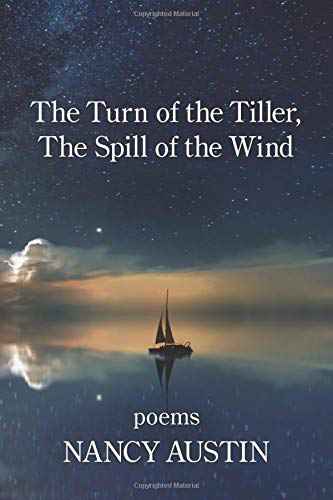
These poems consider life as a voyage, from complex relationships to the ties that bind us to nature.
Readers shared thoughts...
In these honest and sometimes unsettling poems, Nancy Austin takes us on a journey through the joy and pain of life. We become familiar with death but also the “bowls of July.” As I read these poems I feel like I am being followed by spirits of another world as well as the real birds of Earth. The poet’s intimacy with the natural world is evident in her realistic descriptions, inspiring us to take a closer look at the world around us.
—Jan Chronister, author of Caught between Coasts, Casualties and Target Practice.
Nancy Austin builds her poetry the way a sculptor builds a clay model. What the reader sees on the outside is often a view of nature that catches not just the description, but essence of the sights and sounds of the outside world. But it is the armature of human experience that gives the poetry almost a sense of personification. And it is in her more bare-boned poetry that you find that steel armature has a soul.
—Janet Taliaferro, author of Breaking the Surface, A Sky for Arcadia, Virgin Hall and CityScapes.
Nancy Austin’s empathetic ear marks the poems in her new book. True to the title, The Turn of the Tiller; The Spill of the Wind, the poems, predominantly in first person, feature movement and an elegiac tone as unifying factors. One of my favorite selections, The Aerodynamics of the Muse, is a metaphoric description of the process of poetic creation that I wish I had written: “Poems, like paper airplanes, are prototypes/ of the real thing, whose unfolding is in the weight/ of the paper…...” The Secrets of Trees, a lovely piece in which a clump of birch trees reflect human bonds, ends with the Italian phrase meaning “sisters forever”.…… “They lean in, hold each other up, sorelle per sempre.”
—Patricia Williams, author of Midwest Medley: Places & People, Wild Things & Weather and The Port Side of Shadows: Poems of Travel
From the Book
Remnants of Warmth
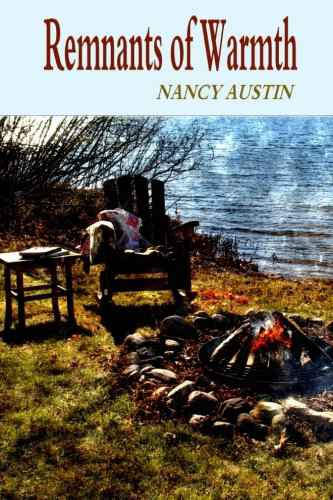
Gumption, grace, betrayal, loss, nature conceits and wit—find them all here.
Readers shared thoughts...
This is a stunning first book, awash with lively language and wry wit. There’s something almost sacramental about her adventurous spirit, audible chuckle, and elegant sensitivity to nature.
—Andree Graveley
The poems in Remnants of Warmth build on memories of childhood and keen observations of life in the Northwoods to create a collection that is both moving and illuminating. Life’s seemingly mundane moments take on resonance and significance, in always surprising ways, in these evocative poems.
—Elizabeth Tornes, author of Snowbound and New Moon
Nancy Austin is a listener who brings the well-tuned ear of a psychologist to her avocation for writing. She feels the pain of the bullied classmate, the belittled wife, the Canada goose whose mate has been shot, and conveys these feelings in poignant poetry. She is delightfully witty, for instance, as she records the uninhibited recovery room comments of a patient following a medical procedure. She also paints vivid pictures of her Northwoods surroundings that reveal her love and enjoyment of the landscape, with its flora and fauna. A lover of vocabulary and explicit nomenclature, she uses precise names for the rocks, birds and trees she observes. Her personal warmth, humor, and commitment to her craft make this collection, Remnants of Warmth, a distinct pleasure to read.
—Elaine Strite Author of Eighth Street Apocalypse
From the Book
Stitching Earth to Sky
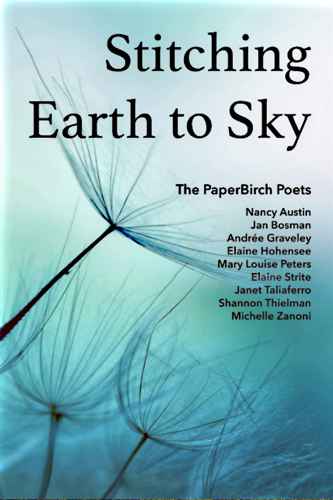
Stitching Earth to Sky is a lovely, soulful, and compelling collection of poems from a group of nine poets from Wisconsin’s Northwoods called The PaperBirch Poets.
Readers shared thoughts...
"It’s always a pleasure to read poetry that is securely grounded in the particulars of a place. In Stitching Earth to Sky we have nine talented poets who evoke with poignant detail, without resorting to sentimentality, the beauty of the lakes, forests and wildlife in Northern Wisconsin. "
—Sarah Juon, author of A Private Passion
"This is a delightful window to the beauty of nature and place as it relates to reflections of the past and present. The poems in this anthology speak of love, death, sisterhood, struggle and triumph. I became immersed in the canvas of nature and life."
—Sue Gehl
"Comfort, sorrow, peace, humor, wit, pathos, grace and growth, gratitude and redemption shine abundantly in the achingly beautiful reflections throughout this collection."
—Linda Bavisotto